
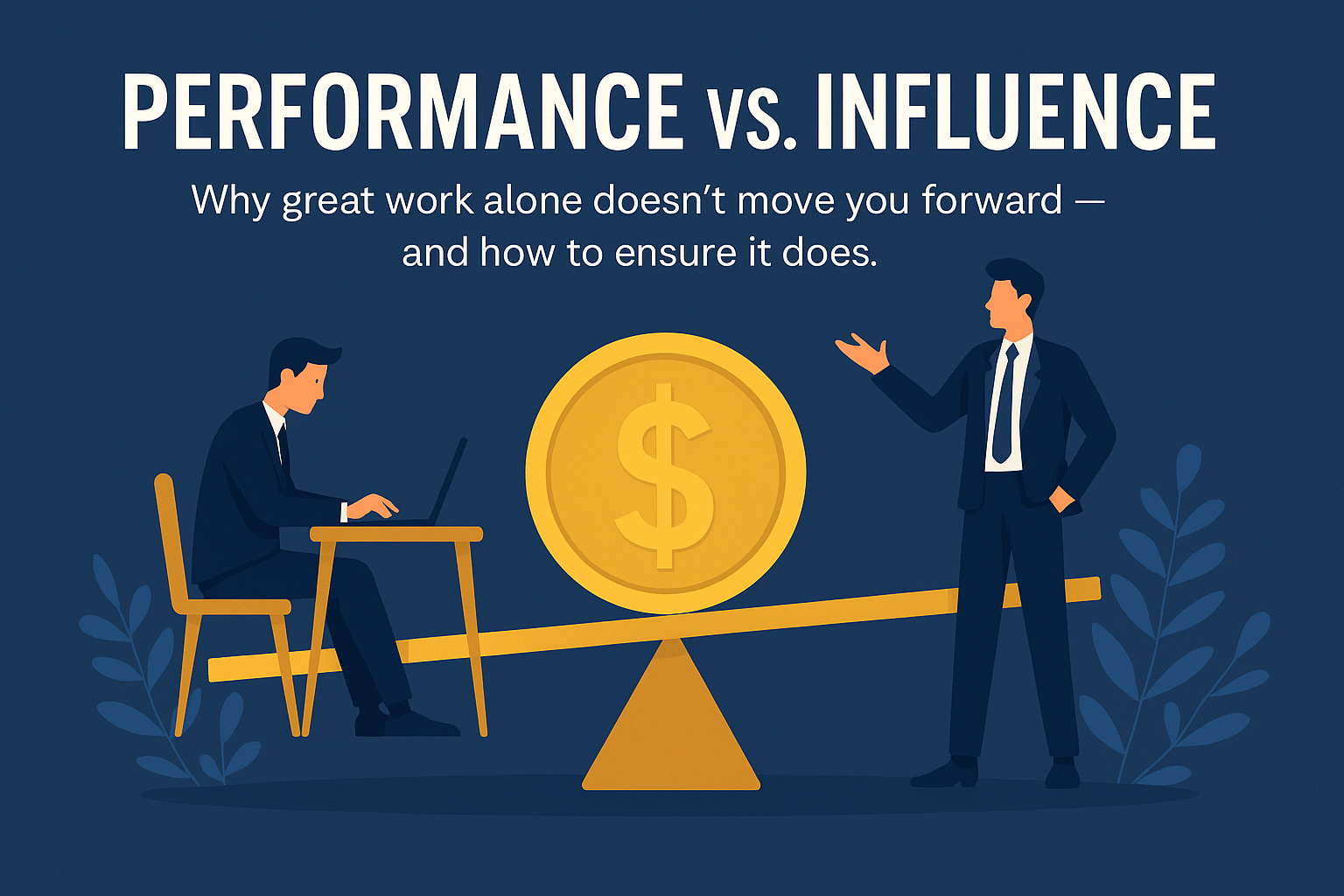

Why great work alone doesn’t move you forward — and how to ensure it does.
1. The Core Tension: “Isn’t doing great work enough?”
Most professionals believe that if they keep their heads down and perform, opportunity will follow.
It feels fair. It feels honest.
But in every organization, you can find someone who works less, speaks more, and keeps getting promoted.
It isn’t favoritism — it’s visibility.
Performance earns credibility.
Influence determines trajectory.
Performance answers the question: Can you do the job?
Influence answers the question: Can you make things happen?
And only one of those gets rewarded long-term.
2. The Myth of Pure Merit
Corporate systems are rarely pure meritocracies.
They’re complex ecosystems of perception, trust, and interdependence.
Work doesn’t automatically translate into recognition because most decision-makers are managing bandwidth, not fairness.
They notice what’s surfaced, explained, and aligned to their goals.
This is where high performers stall — not from lack of skill, but from lack of narrative.
Your results are only as valuable as the understanding others have of them.
3. What Influence Actually Is
Influence isn’t politics, flattery, or manipulation.
It’s strategic clarity in motion — the ability to help people see what matters and act on it.
It’s built through three things:
- Trust – consistent delivery and integrity over time.
- Visibility – ensuring the right people can see the impact of your work.
- Relevance – framing results in a way that connects to what the organization values now.
When these align, your performance starts to carry further. You stop pushing results uphill — the system starts carrying them for you.
4. The Performance Trap
High performers often carry the wrong equation:
Effort = Outcome.
That formula works early in a career, when output is visible and measurable.
But as you advance, the variable shifts from output to influence.
Effort still matters, but if nobody knows, understands, or connects it to strategic outcomes — it evaporates.
While you’re perfecting, others are presenting.
While you’re delivering, others are describing.
While you’re fixing, others are framing.
It’s not about arrogance. It’s about stewardship — making sure the right story travels with your work.
5. Balancing Performance and Influence
It’s not either/or. It’s both/and — but in the right sequence.
| Focus | Early Career | Mid Career | Senior Career |
|---|---|---|---|
| Performance | Learn, deliver, prove reliability. | Maintain credibility and refine your craft. | Delegate effectively; ensure standards stay high. |
| Influence | Observe who decides and why. | Build alignment and visibility around your work. | Shape direction, culture, and vision. |
The progression isn’t abandoning performance — it’s expanding from personal excellence to systemic impact.
6. How to Build Ethical Influence
Influence done right doesn’t erode trust — it multiplies it.
- Translate results into relevance. Instead of “We hit 98%,” say “That 98% saved three weeks on launch and reduced customer churn.”
- Build social capital before you need it. Invest time in relationships that make your results visible.
- Share credit publicly, clarify your role privately. This grows reputation without ego.
- Learn the language of decision-makers. Results expressed in their terms gain gravity.
7. The Mindset Shift
Stop thinking of influence as image-management.
Start thinking of it as impact-management.
Performance is the work itself.
Influence is the echo that keeps the work alive.
If you want longevity, you need both the sound and the echo.
8. The Bottom Line
Performance is the foundation of trust.
Influence is the architecture of opportunity.
You earn credibility through what you do.
You earn movement through how you communicate it.
As we say at PSC:
“Your work only matters if the right people understand its value.”